
Tea is the most consumed liquid in the world after water. Billions of cups of tea are drunk daily, ranging from the quick English 'milk tea' to the highly formal Japanese tea ceremony. But how did this simple drink, made from the leaves of a humble shrub, grow into a global phenomenon? In this article, we travel back in time to explore the rich history of tea.
The legend of Emperor Shennong
As with many ancient traditions, the history of tea begins with a legend. According to Chinese mythology, tea was discovered by accident in the year 2737 BC by Emperor Shennong, who is also known as the father of Chinese agriculture and medicine.
Shennong was an extremely hygienic emperor who demanded that all drinking water be boiled before being consumed. One day, during a journey with his court, the emperor was resting under a wild tea shrub (Camellia sinensis). While his servants boiled water over an open fire, a gust of wind blew some tea leaves into the pot. The water changed color and a delicious aroma arose. Curious, the emperor took a sip and was immediately fascinated by its refreshing effect and unique taste. Tea culture was born.
"Tea awakens the mind, purifies the thoughts, and dispels sluggishness." – Lu Yu, Cha Jing (780 AD)
From medicine to social drink
Although the legend speaks of immediate pleasure, in the first centuries after its discovery, tea was mainly used medicinally. The leaves were chewed or boiled in bitter soups to combat fatigue, promote digestion, and cleanse wounds.
During the Tang Dynasty (618-907 AD), tea changed from a medicine into a national beverage and a refined art form. During this period, the poet and tea master Lu Yu wrote the Cha Jing (The Book of Tea). This was the very first handbook describing tea culture: from the ideal soil types and plucking of leaves to the exact water temperature and correct tea service. Tea drinking became a spiritual act, closely linked to Taoism and Buddhism.
Zen and the Japanese tea ceremony
In the 9th century, Buddhist monks brought tea seeds from China to Japan. They used tea to stay awake during their hours of meditation. Over the centuries, the Japanese developed their own unique tea culture, which reached its peak in the 16th century with the creation of the Chanoyu (the Japanese tea ceremony) under the guidance of tea master Sen no Rikyu.
In this ceremony, which revolves around harmony (Wa), respect (Kei), purity (Sei), and tranquility (Jaku), ground green tea (Matcha) is prepared and consumed in an extremely precise manner. It became an exercise in mindfulness, where every detail in the tearoom had a deeper philosophical meaning.
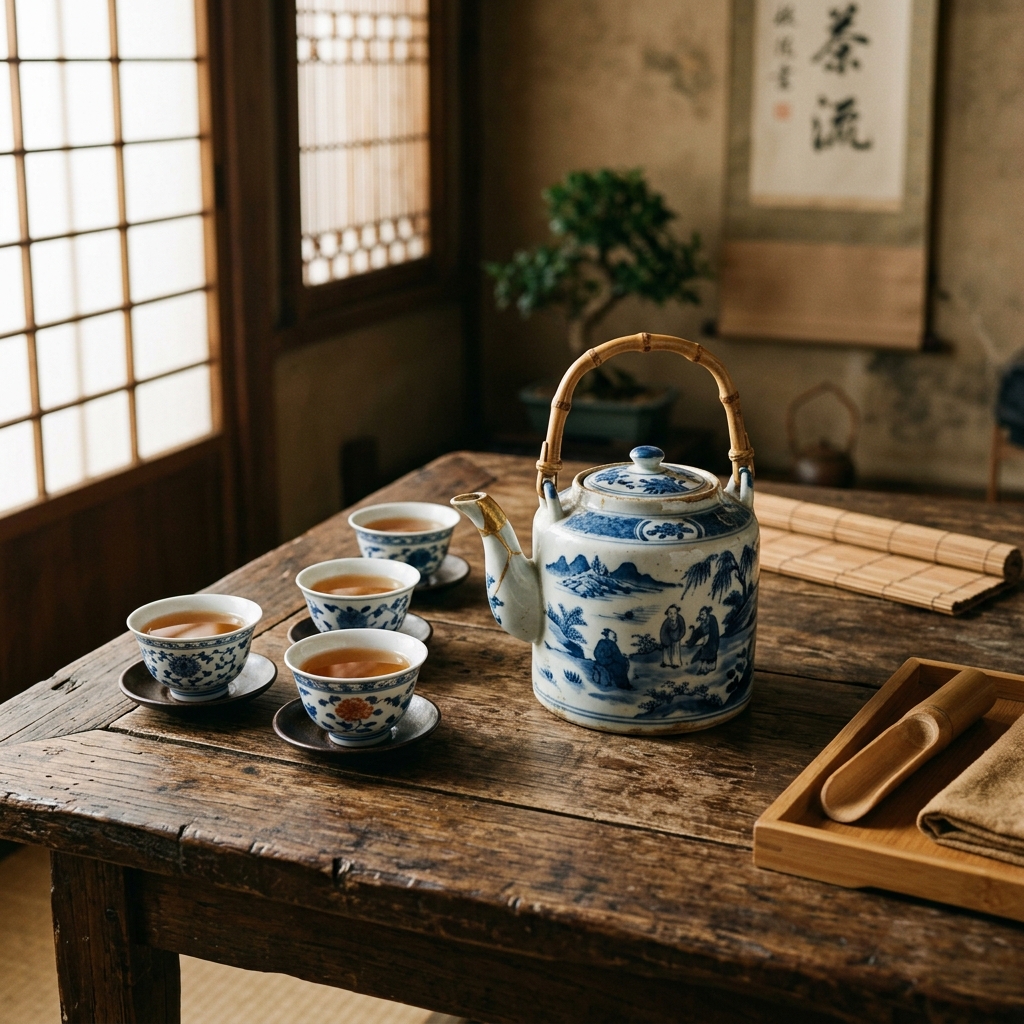
The Dutch VOC brings tea to Europe
Until the 17th century, tea was an exclusive Asian secret. That changed in 1610, when a Dutch ship of the Vereenigde Oostindische Compagnie (VOC) brought the very first shipment of green tea from Japan to Amsterdam. A few years later, the import of black tea from China followed.
In the beginning, tea in Europe was unimaginably expensive. It was a luxury status item that could only be drunk by royal courts and the wealthy aristocracy. Wealthy Amsterdam ladies showed off their wealth by setting up special 'tea rooms' and organizing tea parties, complete with silver teapots and precious Chinese porcelain.
During the 18th century, however, imports via the VOC rose so quickly that prices dropped and tea became available to the average citizen. It slowly but surely replaced beer and gin as the standard morning beverage and laid the foundation for today's tea culture in the Netherlands and the rest of Europe.
The heritage today
At Golden Leaves, we honor this ancient history by adhering to the highest quality standards. Our passion for loose-leaf tea stems directly from the traditions of Chinese tea masters and the refinement of European tea salons. Every sip of Golden Leaves tea is an encounter with thousands of years of history.